For this Blog I will be showing you how I put together the knowledge of everything that was researched throughout this blog to put together a short video which details the ins and outs of using different cameras to create a Hollywood style scene with no budget.
This blog will be an evaluation of everything that was learnt when putting all research to the test.
Firstly, the scene being shot here is a scene taken from a screenplay written by Luke Frewin. To figure out a way to shoot this scene, I had to picture the visuals of the scene for the cinematography. To this I wrote up a shot-list. the shot list consisted of different camera angles, movements and techniques. For example I decided that a Crane/Jib shot would be perfect as a character introduction shot and wrote it down with the corolla-ting segment of the screenplay. This was a great idea as it meant that when coming to shoot the scene, we had already pictured the shot and didn’t need to improvise, making the shoot much quicker and smoother.
The next stage was to storyboard the shot list. Now im am no storyboard artist, that would be a professionals role, however these storyboards made it easier for luke Frewin to understand my vision of the scene as he had Visual reference infront of him.
With this pre-production, we set out to film the scene.
For the shoot we had four different cameras, All ranging at different quality values. The four cameras were:
Blackmagic Ursa Mini 4K
Canon EOS 70D
Panasonic AG-HMC151E
Samsung Galaxy A5
I decided that shooting with four different cameras would be a great way to demonstrate that no matter which camera you have, you can produce an amazing image close to what you see in Hollywood films. The Video Above demonstrates this by cutting the different cameras into their own segments. They all look very similar and in somecases they even look exactly the same. However what was learnt from this was that the different cameras all require different techniques to keep the camera balanced. As you can see in some cases the footage is shaky as the cameras all react differently to stabalizing equipment. for instance
The Blackmagic Ursa Mini 4K was the hardest to shoot with, It was the heaviest camera and didnt fit on the Gimbal or the Steadicam which we had. This camera was the hardest to work with as we had to make the most of the hand held handle which is attached to the camera. This shows that the best kind of equipment, While it looks nice needs big equipment to go with it.
The Canon EOS 70d was the most versatile camera on the shoot, The quality of the camera is all in HD and competes with the Blackmagic Ursa Mini 4K when shooting at HD1080p 25fps and 1/50 shutterspeed. The Canon 70d also fits easily on Stabilizing equipment such as Gimbals and Steadicam’s. However the camera itself is too light which made it awkward to shoot hand held. This caused any Handheld footage to be shaky which means the camera requires stabilizer equipment. While this is a good thing, setting up stabalizing equipment can take up alot of time and isnt always perfect.
The Panasonic AG-HMC151E is the oldest camera used for this shoot. However ironically it was the most fun to use as it made me work more for the shoot. This camera has the lowest quality of the four cameras but it was the nicest to hold because of its weight, despite its cheap feeling plastic shell, This camera ironically proved the point that I am trying to make in this project. You can still use a camera like this one to create an amazing looking Hollywood cinematography. This arguably has improved my experience as a cinematography as it shows that I dont have to rely on a camera such as the Blackmagic Ursa Mini 4K to do all the work for me.
Finally the Samsung Galaxy A5. This camera was the easiest to use as the camera is always set to Auto mode which means you do not need to worry about camera settings. However one of the biggest issues with this camera was the issue I was having with the focusing, The camera liked to be unreliable and constantly switch its focus around, especially on quick moving subjects. This was an issue for this shoot and meant that lots of takes were made with this camera. However with next to no weight from the camera. The camera was easy to set up on the Gimbal meaning that the footage was extreamly smooth.
In preparation for shooting my final Hollywood style sequences, I thought it would be good practice to think about testing out using stabiliser equipment that is going to help me improve the quality of my cinematography to match the standard that is seen in the latest Hollywood releases.
For this Blog post I will be showing my test results and will be speaking about the experience I have had comparing Steadicam stabiliser’s with electronic Gimbal Stabiliser’s equipment
1- Steadicam
Above, is the Stedicam I have purchased. Flycam HD-3000.
I chose to purchase this Stedicam because it is my first Stedicam. It was the cheapest one I could find which does everything that I need it to do.
Pros
Easy to set up
Cheapest on Market
Build Quality
Cons
Heavy
Only one handle to hold stedicam
doesn’t cope well with larger cameras
Time consuming set up
below are the results of my first attempt at testing shooting with a Steadicam.
as seen in the footage above. you can see that the steadicam works well, The footage looses all shakiness and also creates a gliding motion which helps keep the footage from being shaky. However the downside to using a steadicam is that the steadicam creates a swinging motion which is hard to control as the steadicam is extremely heavy to hold and relies on the force of gravity to push it through the motion of movement. The steadicam works best when there is fast movements such as when I was running along the skateboarder in the footage above.
2- Gimbal
A popular Alternative to the Steadicam comes in the form of a piece of stabiliser equipment known as ‘The Gimbal’
This is the Gimbal I chose to purchase. Its a cheaper version of the DJI ronin which is perfect for me being as this is my first Gimbal.
Pro’s
Lighter than the Steadicam
No swinging motion
Joystick
Electronic
Con’s
More expensive
Not great in fast paced shoots
time consuming set up
As you can see in the footage above, Gimbal footage is extremely hard to master. Gimbals rely on perfect balance and makes it extremely hard to think about focus as you have to rely on the cameras auto focus mode because you are holding the gimbal. however, Gimbal footage looks extremely clean when done right. With a gimbal, you loose all camera shake and achieve a floating motion. the gimbal I was using in the footage above also includes a joystick for precise motion.
Comparison conclusion
In conclusion, both stabilzers have their Pro’s and Con’s. The Steadicam is better in a faster paced environment where there is availabilty for lots of movement, however the Gimbal would be better utilised in an environment where there is more reliance on precise movements. For fast paced tracking shots, I think I will use the Steadicam, However for Hollywood style shots like the ‘Micheal Bay 360 Spin Shot’ I will use the Gimbal as it will perform better for a more precise style shot.
Over the period of a month I have been attempting to shoot a film in the style of a ‘Hollywood Blockbuster’. This film has been practice for me to think about how to become the kind of director that the american film industry (Hollywood) would be looking for to work on their films. Of course I do not have the budget to make a fully fledged Hollywood film, however I can try to replicate making one with no budget as long as I stick to the rules of Hollywood film making.
For this Blog I will be Analysing my film to show you how my film takes inspiration from my research around the visual style and production of Hollywood films.
Here is the Film in full, The Film is not finished as it is still a work in progress, However the video will get the point across for my analysis
If you have watched the video above, you will notice that the video is an attempt on replicating what I believe to be a modern take on a very famous, if not the most famous film franchise ever produced by Hollywood, Star Wars. I thought that making a Star Wars film would be a great way to step into the shoes of a Hollywood Director who would be making a real Star Wars film such as George Lucas or J.J Abrams.
After being a lifetime fan of the Star Wars film franchise, I have had plenty of time to analyse the Mise en Scene of every Star Wars film. This includes location and costume.
Star wars is a rather easy film to replicate. The most famous iconography pieces of Star Wars is that of the Jedi, Sith, Stormtroopers and the Lightsaber. I realised that If could get a hold of these props and costume and included them in my film then I would have free range to develop my mise en scene however I like without being questioned.
For location, I needed to find the perfect place that would be considered a timeless location. I did not have the budget to film in a studio or design a set to build, instead i had to hunt for a location which I could pass off as familiar to the Star Wars franchise. Using my knowledge of the Star Wars films, I remembered that in the film Return of The Jedi (1983), there is a long scene towards the final act of the film in which the film takes place on an overgrown jungle or forest planet. I felt that this would be the easiest of locations to find for my film as there are lots of overgrown locations across England, especially where I come from in the UK midlands near the Peak District and National Forest. For the film I decided to use B-roll of the Peak district and the Malvern Hills to establish my setting and also to shoot near a reservoir where there would be a variety of terrain to work with such as sand, rocks and forested areas.
The next step was to design costume for the film, again I had no budget for this film so I had to work with what I could get my hand on for free. This meant searching through my actors wardrobes, trying on my combinations of clothes and rolling with it. I also knew I needed to find a Stormtrooper costume for my film which looked authentic enough to pass off as real. This was not an easy task, as I had no budget and no named experience. However what I did find useful and quite lucky was how I managed to network with a group of charity volunteers who dress up as Star Wars Stormtroopers. Networking with this group meant that I could find time to incorporate an official character into my no budget film for free. Designing costumes was easy as I simply needed to find the most Sci-fi looking clothing I could find. My characters in my script all have dark sides (no pun intended) to them, so I chose to dress them mostly in black which helps create the characters emotional tone on screen. However the last thing I wanted to do was to make my characters look less like they are Star Wars Characters and more Like goths holding glowing sticks. That was the tricky part, however I feel that placing them with a character such as a Stormtrooper helped merge them into the Mise en Scene of the film.
The most important aspect of my short Star Wars film was to work out how I would incorporate working in cinematography which would pass as ‘Hollywood’ quality.
This was one of the hardest parts of the production, as i was running multiple rolls through the production, I was Director, Cinematographer, Editor and Producer. This was alot of shoes to fill and meant that the work load was heavy. “The director is in charge of day-to-day progress of this translation, attending to the preparation staging and enacting of scenes; to the inflections, pace, and mood of the dialogue and action: and to such matters as camera placement and movement, lighting patterns, focus and framing. In some cases, a director’s role is limited to these activities. In other instances, a director’s dominion may extend to every aspect of production, from scripting to casting to final editing.” (Stanley, 2003, p18)
While I believe there are a lot of problems with the cinematography in my short film such as movement and focusing, I believe I have achieved a quality which could pass as a style that is inspired by the cinematography of famous Hollywood Cinematographers such as Roger Deakins or Emmanuel Lubezki. This includes thinking about how the camera moves, is composed and framed, exposed and utalizes depth of field. I also needed to think about which equipment to use for the film. for this film, I worked mostly with using a tripod for dialogue scenes and clear actions shots, a shoulder mount for tracking shots, and hand held camera work to make the action seem more intense and to engage the viewer.
Overall I feel that the production of my first attempt to make a Hollywood style film, is quite successful. I have improved my knowledge to visualise how my films will look professionally, and I have learnt from the mistakes I made during the filming of this test film. I think the biggest mistake I made for this test film was making my shots and cuts between shot too long. The average Hollywood films cuts between shots every two seconds on average. There are parts of this film that break that convention of the traditional film, however I feel there are parts that really work in the style that I am trying to achieve here such as the big action segment I have directed. I think for my final film, I will be focusing on camera movements more seriously and attempt to stabilise them to get the real Hollywood effect.
For all well planned movies, there needs to be storyboards. Storyboards are an important element for all cinematographers who wish to plan out how they are going to shoot the scene of the film. The Storyboard is a tool that is used by multiple people on the film set.
For this post I will be looking at the Storyboards from scenes which are famous for their camera movement and techniques. This will be useful as it will give me an insider view point to how the storyboard artists imagine how camera shots in scenes should be portrayed
Storyboards are important as they help different positions on set, such as The Director who would use storyboards to help them picture the scene, The cinematographer would use the storyboards as a guide to how the camera should be composed for each shot, the producer may use storyboards to understand what is needed for each scenes Mise en Scene and an Editor will use storyboards to help them edit the scenes together along with the script or even creating an edit using the frames from the storyboard which is known as an Animatic.
Jaws Storyboards (1975) – Joseph Alves
Above are some of the official storyboards used in the production of the 3rd act of the original shark monster movie from 1975 known as Jaws which was Directed by Steven Spielberg. Analysis of the storyboards shows that storyboards for Hollywood films are extremely detailed. Typically In a storyboard you will find a drawn out and composed frame which is numbered with a description of what is happening in the frame.
Traditionally the storyboard frame will take the shape of a rectangle to simulate the shape of the camera frame. Most modern cameras shoot in 1920 x 1080 frame size, so this means that the storyboards for that camera shoot must also follow the same frame size. This helps the cinematographer to frame the composition and transfer what is seen in the storyboards to the camera monitor.
Another note here is that the storyboards for Jaws are hand drawn. Whilst in today’s day and age it would probably be quicker and easier and more professional to illustrate the storyboards digitally through a computer programme, I believe that the storyboards for Jaws have that practical feel to them. This makes them feel unique and makes me want to hold them in my own hands.
Compared to the cinematography of today, Jaws’s production would be considered basic. When compared to the Hollywood movies of today which utalise CG digital camera creation and visual effects. It is easy to see that the frames in the storyboards for Jaws were not considering using much movement as the frames in Jaws are often stationary or slightly shaky for dramatic effect. In Jaws we do not see the camera track around characters or do the crazy movements popularized by the next generation of filmmakers such as Micheal Bay – (Transformers franchise 2007- 2018), Zack Snyder – (300 (2016), Watchmen (2009), Joss Whedon (The Avengers (2012), Serenity (2005) or Kathryn Bigelow (The Hurt Locker (2008), Detroit (2017).
This is all from the limitations of which the production of Jaws had with the placement and technology of cameras in the 1970’s. The production of Jaws most likely did not have the technology we have today for Hollywood films, so to counter this, Spielberg and his crew needed to be more creative.
In this shot we see that the camera was strategically placed on a moving platform which is part of the scene to create the motion of movement without actually moving the camera. This scene is great as it started the trend known as ‘The Spielberg Oner’ which would later be built upon becoming more and more advanced in later films.
In conclusion Jaws is one of the most famous Hollywood blockbusters of all time. Jaws set the original foundation for the style of what a modern day Hollywood Blockbusters should look like. The film has inspired many films after it and become one of the films that started the that concept that Hollywoods films would take on a new form. After Jaws, Hollywood dropped the Musical and romance genres. This lead Hollywood film makers instead to take a shine to the idea of making thrill rides, fictional and fantasy films through experiences such as Alien (1979) and Star Wars (1977). Spielberg’s film Jaws had not only changed how Hollywood would produce movies but also changed western cinema as an art form ( The start of the Blockbuster). This could only have been done through the vision of Josephs Alves’s storyboards.
Made up of many different film and TV studios, Hollywood is one of the most powerful businesses in the world, becoming the most popular film industry in the world and taking over the media of the western side of the world. Originating in America in Los Angeles, Hollywood have produced some of the most famous and popular films of all time.
For this blog I will be analyzing Hollywood films an Directors to explore what exactly a hollywood film theory is.
“Film theory is a generalizing practice concerned with the basic
signifying procedures and underlying conventions of cinema which at its broadest
would seek to account for the aesthetic, psychological and social dimensions.” (Maltby,
2003, p526)
World Building – The Avengers (2012) – Joss Whedon
The Avengers (2012) is arguably one of the biggest hollywood movie releases of the 2010’s decade. Directed by Joss Whedon of Firefly (2002-2003) and Serenity (2005) fame, The Avengers grossed over $1.5 billion dollars world wide and is currently in the top ten highest grossing films of all time list.
How did this film become a significant part of film history? The film was escalated by the popularity of the Marvel Cinematic Universe world building. The Avengers was the 6th film in an ongoing film universe built up from four major Hollywood film franchises. This meant that the audience for The Avengers was broad with many fans eagerly anticipating what would feel like a pop culture event. The Avengers was a game changing film as it became apparent that major film studios needed to change their business plans as Marvel Studios popularized the idea of film franchise universe, which was then copied by Warner Bros ‘DC universe’ films and Universal’s short lived ‘Dark Universe’.
The Avengers also stars some of Hollywoods biggest A list actors in the world currently such as Robert Downey Jr, Chris Evans, Scarlett Johansson and Samuel L Jackson. These are actors with great acting reputations in Hollywood and the ability to sell any film as they are named you already know as well as the popularity of the source material and comic book sub-culture popularity which helped put numbers in seats.
Style – Transformers (2007) – Micheal Bay
Transformers is one of Hollywoods go to franchises. While the films are often critiqued as bad movies, they became really influential for the big hollywood studios as the Transformers movies paved the way for the look of the the computer graphic era of film making. Directed by Micheal Bay, the transformers franchise became on of the most successful franchises of all time with 2 of the films from the franchise being in the list of 25 highest grossing films of all time.
The original live action Transformers film from 2007 became the staple for the style of every Hollywood film after its release. Style includes, Lens flares, digital editing, Digital camera movements, explosions, CGI characters and helped bring back the popularity of the 80s style Sci-fi and Superhero movies. Whenever you watch a Hollywood film, think of the transformers films and you will see the influence Micheal Bays famous style of explosions, erratic acting and camerawork has had on most big budget Hollywood films.
Compared to the blocky style of the Transformers toys, animated tv show and cartoon filmsof the 80s and 90s, Transformers 2007 took a different style as the design of the transformers changed to a more mechanical and believe-able style to appeal to an audience with higher expectations.
Transformers is a movie which is made to sell toys. This is proven by the amount of transformers toys which were sold after the films release.
Larger Than Life Characters – The Godfather 1972 (Francis Ford Coppola)
Arguably one of the most famous films of all time, and also in most top 10 movies of all time lists, The godfather is the literal godfather of all Hollywood films that focus on character building.
Marlon Brando, an acclaimed actor who is often considered one of the greatest actors of all time. Brando character ‘Don Vito Corleone’ really represents what hollywood look for in their films. Hollywood looks for the largest stories from larger than life characters. Characters that people can get behind, characters that the audience can relate to or characters that the audience strive to be. Brandos ‘Don Vito Corleone’ is one of the most recognizable characters in the whole of Hollywood History, Even if you haven’t seen The Godfather (1972) you have definitely seen the iconography the character has inspired. The character of Vito Corleone has also inspired and been parodied by other famous characters from Hollywood films such as Jack Nicholson and Jared Leto’s Joker from the Batman Franchise, Jabba The Hut in the Star Wars Franchise and of course every character Al Pacino has played since his role in the Godfather (1972).
In conclusion Hollywood has become the most influential film industry in the world. Every film industry outside of Hollywood is inspired by the modernity of what Hollywood are doing. This is because the Hollywood industry has mastered the formula to making films that are respected across the world with their Style, Larger than life characters and the many worlds generated from the army of famous and popular directors Hollywood has under their belt. Hollywood caters to everyone in some form or another.
For This weeks blog I will be looking at films that have a small budgets but can compete with films that have Hollywood quality productions. The reason for this will be so that I can analyse how to produce a Hollywood level production from having little to no budget. This will lead me to explore a more mainstream style of film-making that is important as it is expected by today’s standards to be able to make a visually pleasing films on the cheap that can also entertain its viewers.
Paranormal Activity (2007) is an American Horror film directed, filmed and edited by Oren Peli, paranormal activity is popular for is stylistic choice to utilise the idea of the found footage concept made famous by other films before it such as The Blair Witch Project (1999) another low budget Hollywood film.
The Found Footage is a genre is a genre of film that is often associated with fantasy or horror, The idea of found footage is in its name, Its the concept that someone has found hand held video footage of an event and chosen to display it to the public audience.
This technique of film-making has been popularised since paranormal activity (2007) was released as the style has been replicated in big budget fantasy and horror films such as Troll Hunter (2010), Chronicle (2012), Cloverfield (2008) and of course the countless amount of big budget Paranormal activity sequels that have been released.
Paranormal Activity achieves its Hollywood production level because of its use of practical and special effects, Hand Held Visual style (video quality) and video quality sound design
“As you may have guessed by the whole video camera thing, Paranormal Activity is one of those “found footage” jobbies in the style of The Blair Witch Project, Troll Hunter and Cannibal Holocaust in which it’s claimed that the people in it are completely real and the events actually happened. It opens with a message of thanks to the parents of the two lead characters for their co-operation, and closes with a simple copyright message with no credits whatsoever as if to suggest nobody “worked” on it and it’s just some footage that a couple shot themselves” (That was a bit mental, 2012)
In this scene you can see the use of practical effects ( Micha’s body being thrown) Sound Design (the unusual Bumps in the night, Long moments of no sound and jump-scares) Visual Style (simple one shot on tripod with great framing) Special effects ( Time of day in corner of the screen which gives off the video camera effect)
Paranormal activity grossed over $100,000,000 at the US box office which proves that there is a place for low budget movies in Hollywood that are shot in a more stylistic way
2- Primer (2004) Shane Carruth (Dir) – $7000
Primer(2004) is a low budget american Sci-fi film, Primer is a film which takes its influences from Hollywoods Sci-fi conventions but also plays on viewer expectation, Primer (2004) is not your average sci-fi film, Its a film that challenges its viewer as it takes away all expectation towards the enjoyment of science fiction and throws you into a conversation with men who all have PhD’s in nuclear science.
primer is a prime example of a science fiction film that focuses less on science fantasy but more on the characters involved, Think the Big Bang Theory but without the comedy and scientifically correct.
Not only is the film written as a super in depth puzzle box for every person who watches but the film also utilises most cinematography techniques popularised in modern cinema such as Hand Held, Tracking, Focus Pulls, Pushing in and dollying. The film also uses a green, blue and brown colour grade which can be compared to films by David Fincher such as Se7en (1995) and Fight Club (1999)
Primer (2004) is a unique film but also rewards the viewers who manage to stick with it and complete the puzzle, This means that film really needs to be watched multiple times to really understand the narrative which is often a technique Hollywood films have utilised in the past with films such as The Sixth Sense (1999) Donnie Darko (2001) and again Fight Club (199)
“The budget was reportedly around $7,000, but that was enough: The movie never looks cheap, because every shot looks as it must look. In a New York Times interview, Carruth said he filmed largely in his own garage, and at times he was no more sure what he was creating than his characters were. “Primer” won the award for best drama at Sundance 2004.vents without explanation, chronologies that don’t seem to fit.” (Ebert, R. 2004)
3 – Tangerine (2015) Sean Baker (Dir) – $100,000
Tangerine (2015) is an independent American LGBT film. Tangerine found its publicity for being considered as one of the first films to be filmed entirely with Iphones. Tangerine broke waves after being premiered at the Sundance festival 2015 in Park City Utah. The film won countless awards since its premiere, Notably :
2015 – Audience Award, Gotham Independent Film Awards
2015 – Best Supporting Actress (Mya Taylor), San Francisco Film Critics Circle Award
2015 – Breakthrough Actor (Mya Taylor), Gotham Independent Film Awards
2015 – Directors to Watch, Palm Springs International Film Festival
2015 – Stanley Kubrick Award, Traverse City Film Festival
Tangerine is an interesting film as it is often questioned why Sean baker decided to use Iphones for this film when he had access to $100,000. To answer this I actually managed to ask Sean Baker himself this very question through a skype call at my university. Sean answered that he decided to use Iphones because they were simply cheap and easy to use. He also mentioned that he was able to use small Kickstarter lenses which attach to the Iphone and a special Iphone app which let Baker control the Iphones shutter speeds and aperture manually.
“Sean Baker’s micro-budget buddy comedy Tangerine caused a major stir at this year’s Sundance film festival following the reveal that the gorgeous-looking film was shot on iPhone 5s, something the film-maker had managed to keep a secret up until its world premiere.” (Smith, N. 2015)
Tangerine has been an influential film, It has inspired well known directors such as Steven Soderbergh to approach the same technique of using Iphones for their films Soderbergh used this technique in his psychological thriller film Unsane (2018)
Camera movements are one of the most important aspects of cinematography. The dynamics of a camera movement is important, as movement on screen is what distinguishes the differences of cinematography between other media forms such as photography, painting and other visual mediums. Camera movement is important in a film as movement can also help tell a story.
For this post I will be looking at how Hollywood productions have utilised advanced camera movement in famous movies. This will help me understand the dynamics of composition and movement in the frame.
“A Great deal of visual effects work can be accomplished
with conventional cameras and equipment. In fact, there is not a clear dividing
line between standard production cinematography and special visual effects.”
(Perisic, 2000 ,89)
1 – The Push In
“Move the dolly toward or away from the action. Common terminology
is push in or push out” (Brown,2002, p64)
The ‘Push in’ is a camera movement where the camera moves forward towards its subject, usually toward the eyes. This movement can have many uses, however the Push In is usually used to express moments of realisation, the connection between two characters, sadness or even power within the subject.
The Push in movement is different to a track in shot as the subject does not move with the camera but instead lets the camera move towards it.
In this famous Spielberg scene from Indiana Jones and the Raiders of the Lost Ark (1981) The Camera pushes in on Indiana Jones (Harrison Ford) as he has the realisation that he is about to be chased by a giant boulder. The Camera moves towards Fords chin as this helps exaggerate the amount of danger Jones is in as he looks up.
“The punch in is different from a push in, which actually
involves moving the camera, a punch-in means that the camera stays where it is
but a longer focal length prime is put on or the lens is zoomed in for a
tighter shot” (Brown,2002, p66)
2- The Push Out
The alternative to a Push in shot is the Push Out shot. The Push Out is used to take the audience away from the action. For example the camera may move back from a close up shot to a wide or long shot. This movement creates the feeling of uneasiness, dread, detachment, greif or fear. For example this type of shot could be used to end a scene after a dramatic amount of violence or maybe to build emotion from a character as you say goodbye to them, ending your connection.
In this shot from 20th Century Women (2016), a push out shot has been used to end the scene. This is the final scene of the film and we are saying goodbye to Annette Bennings character Dorothea Fields which the push out shot helps exaggerate.
3 – The Spinning Camera Technique
The spinning camera Technique is a popular technique that is used within Hollywood films. The dynamics of this technique is that the camera spins up to 360 degrees creating an effect that can literally spin the composition of the frame. This technique can be used in many different ways. For example this technique could be used to make the world feel like it is upside down. This technique has been used in films such as Black Panther (2018) or Spider-man 3 (2007) when Peter Parker played by Toby Maquire wears the Black Spider-Man suit for the first time. The transition to or from right side up helps create the feeling of being upside down for the audience.
In this shot we can see the Villanous Killmonger, played by Micheal B Jordan walking to his newly claimed throne. The camera cleverly spins from being upside down to right side up as it tracks behind him. This shows the imbalance Killmongers reign of terror is causing on the land of Wakanda.
4- The Micheal Bay 360 Shot
Despite what you think of Micheal Bay, he has gifted us with one of the most powerful looking camera movements being used today in all of Hollywood. The Micheal Bay 360 shot is an advanced camera movement that tracks around a subject to create the sense of someone or something being epic. Micheal Bay’s films are famous for being constantly on the move, in other words, the camera does not stop moving. The 360 shot is his most recognisable shot in his films and is being used by other filmmakers also in non Micheal Bay films such as The Avengers (2012) by Joss Wheedon where the 360 shot is used to create the sense of heroism and unity when the various superheros finally come together to win the final third act battle. This style of film making inspired by Micheal Bay has come to be known as Bayhem.
The most famous shot from The Avengers (2012) is a Micheal Bay style 360 shot even though Bay had no involvement with the film. This shows how dynamic and epic this shot can be as this shot is now iconic for the superhero film genre.
5 – The Crane shot
The Crane shot is one of the most ambitious shots in all of Hollywood. The Crane shot is a camera movement where the camera is lifted into the air away from its subject often into an epic wide angle long shot.“The most useful aspect of a crane is its ability to achieve large vertical moves within the shot.” (Brown,2002, p66). This shot is created using a camera jib/crane to reach the high up in the sky effect. The reason this shot is often used is to make the subject feel like they are a small fish in a big pond, as seen in the film High Noon (1952) where Marshal Will Kane, Played by Gary Cooper is made to feel like an Ant as he is abandoned by the towns folk he cares for because of the looming threat of the vengeful Frank Miller.
“These used to be enormous heavy contraptions that physically
lifted the camera operator with the camera. They required at least one other
person driving, swinging or pushing it around.” (Fairweather, 1998, p22)
“Modern cranes tend to be operated from the ground by remote
control. They are far smaller than the traditional designs, easier to
transport, cheaper and can be operated with a smaller team. Typical is the
Jimmy Jib, which can be up to 36 feet long, and operated by a single person.” (Fairweather,
1998, p22)
This shot can also be used to create world building landscapes.
A landscape Crane shot in The Lord of The Rings: The Two Towers (2002)
6 – The Dolly Zoom technique
The Dolly zoom is one of the most recognisable camera tricks known in Hollywood. It has been used in multiple films throughout the history of film and has been used in many different creative ways. A Dolly zooms technique is literally in the name. this technique is when you combine a dolly track movement with the zoom feature on a camera lens. This technique creates a strange distortion effect which can be used to portray how a character is feeling.
Famously Spielberg used this technique in the blockbuster film Jaws (1975) to create the feeling of dread from his character Chief Martin Brody who was played by Roy Schneider This effect was used when Chief Martin Brody has the realisation that a child is eaten by a shark on the beach he is patrolling in one of the most famous scenes from the film.
The Technique was also famously used in Alfred Hitchcock’s film Vertigo (1985) which as the name of the film suggests, was to create the effect of having vertigo sickness. This version of the Dolly Zoom was different to spielbergs as it was shown in the first person view, which spielbergs Dolly zoom wasnt. This shows the creative ways this camera technique has been used.
Raging bull (1980) by Martin Scorsese used the Dolly Zoom technique to show the effects of being on the verge of being tired and knocked out as we can see that it is filmed to replicate Robert De Niro’s character Jake La Motta’s point of view. This shot was also used to express the feeling of Jake La Motta losing the upperhand.
Being creative with camera movements is one of the most tricky parts of being a cinematographer. It is great to be able to know how to work with video cameras including what seems like endless amounts of buttons and menu options, however what distinguishes the difference between an amateur and a professional cinematographer is if they can handle and work well with the tools that are built to extend their arsenal of cinematography skills such as moving, stabilising and composing a frame. All of these skills are used by professionals in the film industry to get professional results.
This weeks blog will be a research into the equipment that is being used within the industry today to achieve the professional results that are similar to the quality of production you are likely to see in a big budget Hollywood film.
1 – Tripod
Arguably the most essential piece of equipment for any cinematographer is a tripod. Tripods are the most versatile pieces of equipment that every filmmaker should know at least the basics to.
A tripods job is to stabilise key equipment, most notably cameras. Made up of three legs, tripods keep everything steady and take away camera shake as all weight from the camera is placed upon the tripod. Tripods are usually stationary, providing no movement.
Most professional tripods include changeable heads. The two main heads for tripods that most camera operators use are, photography heads and video heads. There are pro’s and cons for both of these types of heads.
Photography heads are more common for studio photography use, you would use a photography head to capture long exposure photography as it is practically impossible to capture a sharp long exposure images without a tripod. Photography heads can tilt in 3 axis which allows the photographer to swap from landscape to portrait or even slanted if the photographer desires. This kind of head would be useful for documentary. You would not use this kind of tripod head in a live shoot as it would be too finicky.
Video heads are designed to be more fluid. This kind of head would be more useful in a film shoot or live shoot. Fluid heads are designed to be panned, tilted or even panned and tilted at the same time. This kind of head gives the filmmaker free range to record the action without the need to change the axis on the head. Video heads are extremely useful for shooting video footage whilst keeping every movement smooth, however this kind of head would be impractical for a photo-shoot as fluid heads can be a pain to keep still and provide mostly only horizontal shooting. Fluid video heads tend to more expensive also.
Tripods are only useful if they are stable. It is important to find the right kind of tripod that creates the perfect balance of weight and stability. Some tripods are sturdy and feel well built but provide poor stability which is not useful if you have a large format video camera on top as it could potential cause damage. Some tripods are really not practical at all. Plastic tripods should be avoided for professional work as they damage easily as the build quality often causes issues with weight and stability. Most professional studio tripods are made from metal and weigh a lot which is useful for shooting but not for mobility, These kind of tripods are not designed for transporting. If you’re moving around to different locations with a tripod, it would be wise to find a tripod that is not overly heavy but still provides enough weight to keep the tripod stable so that it will not fail in such environments as a windy area or an area with unstable terrain.
2 – Monitors
Monitors are important for cinematographers. A monitor is used in a film or video shoot so that the cinematographer has a clear view towards what is in focus in his frame. A monitor is usually a 5 – 7 inch TV screen that connects to a digital camera giving a clearer view point for the cinematographer to see what they are filming. The larger the monitor, the easier it is to see how well the camera is coping with focus, white balance, frame rate, image sensitivity optimisation (ISO), shutter speed and aperture F stop/ depth of field.
3 – Steadicam stabiliser
Steadicams are an essential tool for cinematographers who need to get into fast paced action with a video camera. Steadicams are built so that they can be used in fast paced film shoots. A steadicam will stabilise shots that require lots of quick movement such as a running scene where the cinematographer will need to run alongside his subject.
“A device called a Steadicam – consisting of a lightweight
frame, torsion arm, movie camera, and small video monitor- can be attached by
harness to an operators body, making possible movements similar to thoseachieved
with a dolly.” (Stanley, 2003, p71)
Steadicams are heavy pieces of equipment and often require the cinematographer to wear a harness for the steadicam to keep the weight lifted from the person holding it. The harness makes it easier for the cinematographer to cope during long periods of shooting.
Steadicams are also extremely difficult to balance as this piece of equipment relies on gravity physics to help keep your camera up straight. This is achieved by using weights at the bottom of your steadicam to counter balance the weight of the camera on top. To stop the camera from falling forward on the steadicam, you also have to work out where the camera needs to sit on top so that it’s weight finds centre of gravity which stops the camera tipping forward or backward.
Moving around with a steadicam can be tricky as you will likely be turning with the steadicam. Gravity does not naturally let the camera turn with you, to avoid this you have to pinch the middle of the steadicam to keep it turning with you. Pinching the steadicam also reduces swaying from the fast movements you will be making with it.
Steadicams leave you with professional results that include clean camera movements if used correctly. Your cinematography skill will be taken to the next level.
“The Steadicam revolutionized camera movement. It can
smoothly move the camera in places where a dolly would be impractical or
difficult such as stairs, rough ground, slopes and sand.” (Brown,2002, p76)
4- Gimbal Stabiliser
Gimbals are more technologically advanced steadicams. Gimbals tend to be smaller and are more co-operative to use, however this does not mean that gimbals should be used over steadicams.
Gimbals are electronic versions of steadicams, they have exactly the same role, however gimbals are more precise and are used in a more controlled film scenario. Gimbals can be used to create slower and more precise stabilised movements, such as tracking around a subject, pedistalling up or down the subject or dollying forward towards a subject.
Gimbals are completely automatic and work on 3 rotational axis to help keep the camera completely stable. Gimbals would not be a wise option to use in a fast paced environment as depending on which gimbal you use, the gimbals motors struggle to keep up with your movements.
Gimbal footage often look alot cleaner than steadicam footage and is the prefered choice for many, however is it useful to think strategically about which of the two stabilisers would be best for the given situation. A steadicam would be best for live shooting whereas a gimbal would be best for controlled filming in a film shoot.
5- Shoulder Mount
Shoulder mounts are great for keeping light weight camera stable whilst keeping the natural movement style that you would achieve from holding a camera handheld. Shoulder rigs are designed to create an effect where the viewer feels that they have been pulled into the scene in a voyeuristic manner. A shoulder mount also gives the cinematographer complete free range to move about.
Cameras are becoming much smaller as digital technology advances, this is shown by the size of the professional DSLR video camera that are being used today. Smaller cameras are more susceptible to camera shake which can ruin footage, this is because DSLR cameras are lighter to hold compared to the bigger video cameras. To counter camera shake, shoulder mounts are used. Shoulder mounts are a metal rig that is places above the shoulder. At first, a fully equipped shoulder mount can be quite a heavy piece of equipment. This is not how shoulder mounts should be. To counter the weight of a shoulder mount, it is advised to find the centre of gravity above the shoulder, then its is important to weight down each end of the shoulder mount so that the shoulder mount is able to sit on the shoulder without falling forward or back. Weighting the shoulder mount is important as it relieves the cinematographer from becoming exhausted from holding a heavy rig all through their shoot as the weight creates a floating feel for the cinematographer on the shoulder. The cinematographer can also use their body to keep the camera stable.
For this blog post I will be discussing the cinematography of five cinematographers that have all had parts in famous Hollywood movies. I will be researching these cinematographers to analyse what kinds of techniques they have been using throughout their careers, techniques that are instantly recognisable and have shaped the form of modern film-making we know today.
The focus on this research will be to understand the quality of modern cinematography by looking at five of the most popular cinematographers in the industry today, so that I know what standards I am looking to achieve to be taken seriously as a professional cinematographer, starting with.
1 – Roger Deakins
Roger Deakins (Far Right) Adjusting Lighting on set
Roger Deakins is an Oscar winning cinematographer known for his eye to capture beautiful, photographic like visuals . Deakins has expressed that he does not have a style but would rather focus on capturing what would be best for the emotional significance of the scene. This means that Deakins avoids using movement and stylist techniques if they are not needed. This is shown in his recent work for films such as Blade Runner 2049 (2017) and Skyfall (2012), where Deakins perfectly captured the emotion of the on screen characters by focusing less on style and more on substance.
Deakins also likes to shoot wide shots with medium distance from his subject, this creates an epic scale of world building. Wide shots make you feel like you are in the cinematic world.
A distinctive technique that Deakins uses is shown in Bladerunner 2049 (2017). Here Deakins uses multiple tracking shots so that we are taken even further into Deakins’ vision of world building. To advance on tracking shots, Deakins uses punch in shots, which are tiny tracking movements which draw your attention to the subject as the tracking movement gets closer to its subject.
James Bond walks into shot with a stroke of light on his face to express that he is a dark character with a lighter side.
Using warm coloured lighting, Deakins expresses James Bond’s charm in a Chinese themed setting to create a romantic scene.
The villainous ‘Silver’, played by actor Javier Bardem is silhouetted in front of a burning building. Deakins uses the back light radiating from the burning fire to create a dramatic and horrific image that truly captures the visuals of evil. Tarkovsky films were greatly used as influence here.
Using silhouettes is a reoccurring theme throughout Skyfall. Here the lighting and framing expresses urgentness. This scene uses cold blue light and blacks which is often used in colour theory as an indicator of death or sadness, however in this scene I believe that Deakins uses blue as a colour to represent espionage.
Deakins Oscar winning cinematography comes from Blade Runner 2049 (2017). Here we can see Deakins’ influences as this shot could be taken from any of Stanley Kubrick’s films that were shot by John Alcott or Geoffrey Unsworth. This is because of the one-point perspective creative choice that Kubrick greatly used in his films.
“Deakins is truly an artist. His talent of cinematography has created such amazing scenes which were simply perfect. The subtle revelations, the steady spiraling zoom, the focus. And his perfection of delivering the scene in just the way it was desired to create the perfect effect makes him one of the busiest and best cinematographer in Hollywood.” (Indie Film Hustle, 2018)
2 – Emmanuel Lubezki
Lubezki on set with Alejandro G. Iñárritu.
Emmanuel Lubezki is a three time Oscar winning cinematographer. He is most notable for being the director of photography (DOP) on films such as Birdman or (The Unexpected Virtue of Ignorance) (2014), The Revenant (2015) and Gravity (2014). Lubezki has become known for his incredible long one shot takes.
“Lubezki is no stranger to long takes. Well before Birdman came along, he developed the long intro for the film The Birdcage, which clocks in at over 2 minutes before a real visible cut is seen. Of course, with Lubezki it’s not just about the long take… it’s about the motion during that take, whether it’s a long take or not.” (Paul, J. 2015)
This can be seen in most of the films he has been DOP for. Lubezki has become popular in the industry for popularising a style which is often replicated by other cinematographers. Lubezki’s style pulls the audience right into the action by letting the viewer feel like they are part of the film as a character looking through the camera glass as their eyes and using human like movements (camera shake) to simulate braking the fourth wall. This is most notably seen in a heavy action scene from the underrated Children of Men (2006) where the camera simulate an extra character in first person perspective running through the scene along with the main characters. https://www.youtube.com/watch?v=55NfxbBgWRA
Children of Men in my opinion is one of the best examples of cinematography of all time. The cinematography is flawlessly choreographed as well as visually stunning. This film set the bar.
“Emmanuel Lubezki, or “Chivo” as he is sometimes called, is a brilliant cinematographer whose uncanny eye for framing and sense of movement is quite possibly unmatched. I’ve been aware of Lubezki for many years through his work on Sleepy Hollow and Meet Joe Black, but it wasn’t until The New World and Children of Men that I stopped to admire and love the way he uses the camera like a painter does a brush on a canvas.” (Paul, J. 2015)
3 – Wally Pfister
Wally Pfister taking a light reading of Leonardo Di Caprio’s face.
Wally Pfister is an Oscar Winning Cinematographer. He has become know for his role as Director of Photography on many of Christopher Nolan’s movies, such as The Prestige (2006), Batman Begins (2005), The Dark Knight (2008) and Inception (2010). Wally Pfister has claimed that his cinematography is naturalistic. This is shown by how his frames are rarely lit by unnatural lights. Working with Nolan means that Pfister pushes the boundaries by filming with only the best camera equipment available. Nolan’s budget goes on making his film’s production as big as possible, using IMAX and film stock. Pfister is a specialist in this kind of equipment and works fast along with Nolan who only works fast.
“He and Nolan generally covered scenes with a single camera. The exception to that rule were action sequences where two or more cameras provided coverage from different perspectives. Pfister is a former news cameraman who generally does his own handheld shots. He made certain the cast knew he had their interests at heart. “ (Sudhakaran, 2016)
Despite Pfister saying his frames are natural, it is obvious that Pfister does work with lighting to some capacity. He ignores the three way lighting formation which is the most common form of lighting a scene and instead will light his subjects from the side to create shadows. This is seen in all of Nolan’s films. Pfister will also utilise the location and studio set to create silhouettes from overexposing lighting behind a subject and creating soft light from windows.
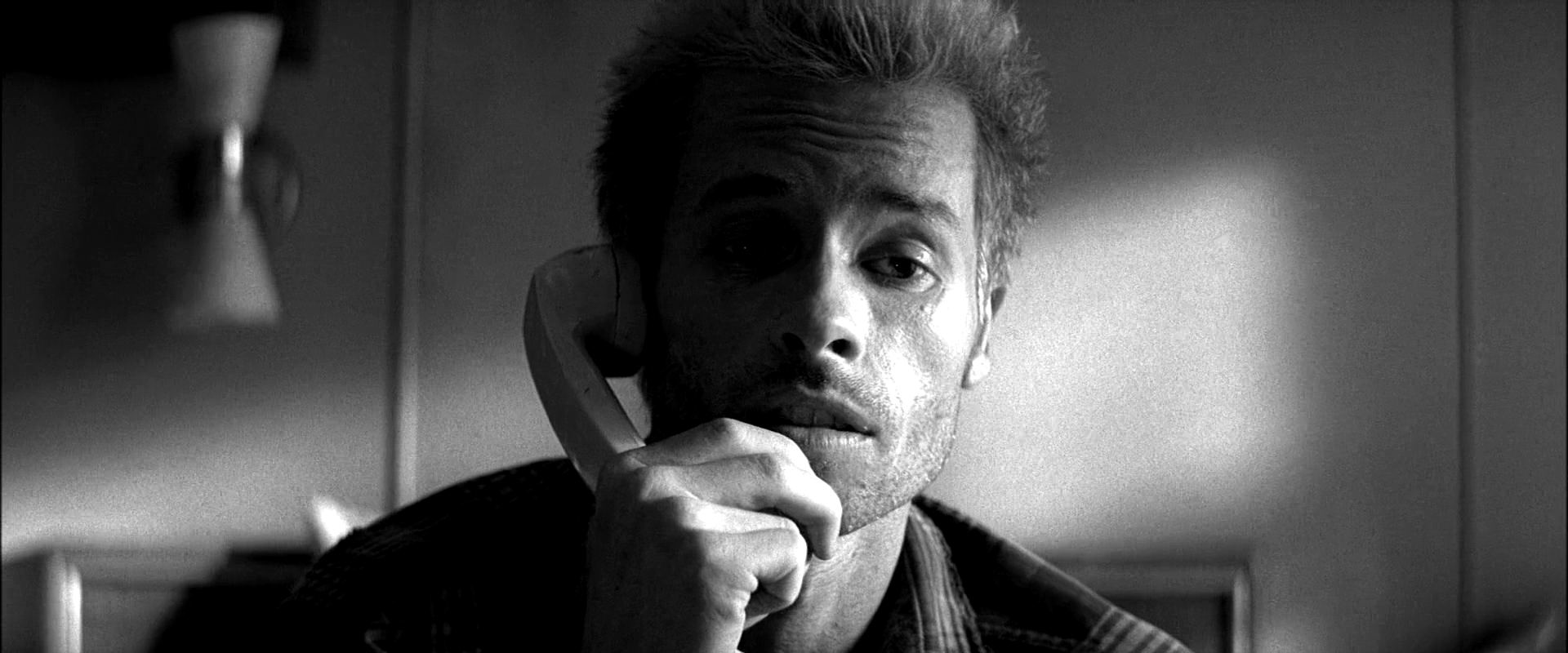
Here Guy Pearce is being lit directly from the right side of the frame using light from a window to create a shadow on the right side of the face. This is similar to Roger Deakins work on Skyfall (2012). This image has also been over exposed so that the contrast in the shadows really stand out.
Christian Bale’s Batman is lit from behind to create a silhouette from the giant window light source in the background.
A very natural light image, Hugh Jackman is completely lit without artificial lighting but is being lit by his surroundings. Shallow depth of field (Bokeh) is used here to create a 3D looking image.
“Wally Pfister prefers to call his style naturalistic. I don’t agree with the terminology, because even though his shots look unlit to the general audience (any good cinematographer should be able to do so), they don’t look unlit to the trained cinematographer’s eye. There are other cinematographers with more naturalistic styles, and sometimes it’s hard to tell whether it was lit at all.” (Sudhakaran, 2016)
4 – Robert Richardson
Robert Richardson (Left) using a Panavision 70mm on the set of The Hateful Eight (2015).
Robert Richardson is known for being one of the worlds leading cinematographers. He has three Oscars and is known for being the Director of Photography for multiple of Quentin Tarantino’s films. These films include, The Hateful Eight (2015), Django Unchained (2012) , Inglourious Basterds (2009) and Kill Bill Vol 1 and 2 (2003 -2004).
“Prior to becoming a regular collaborator with such prominent directors as Oliver Stone and Quentin Tarantino, cinematographer Robert Richardson served his apprenticeship shooting second unit on Repo Man (1984) while filming television documentaries for PBS and the BBC.” (RobertRichardson.com)
Richardson’s technique is to use harsh outlining around his subjects from backlights. This is because Richardson is lighting from his vision of the story. He uses outlining to draw the eye to the subject on screen, he really wants to focus on what he notices in the frame. Of course back lighting could potentially lead to an underexposed and quite dull and silhouetted frame however, Richardson bounces the backlight around his location to key light the rest of the frame.
Samuel L Jackson is lit heavily from behind. This has created a very light outline around him which helps draw the eye to him. This shot has also been lit from above as you can see by the blown out highlights on Jackson’s gloves. The gloves reflect the overhead light and help bounce the light onto Jackson’s face.
“while occasionally branching out to shoot films like John Sayles’ Eight Men Out (1988) and City of Hope (1991). But it was his stunning work using a multitude of stock and cameras to create a documentary feel for JFK (1991), which earned the cinematographer his first Academy Award.” (RobertRichardson.com)
5 – Jeff Cronenweth
Jeff Cronenweth on the set of Taylor Swift’s – Shake It off (2014).
Despite being the only cinematographer to not win an Oscar on this list, Cronenweth has ranked up with the highest of the modern day cinematographers working in the industry today. He has worked with the likes of David Fincher as his DOP on films such as Fight Club (1999), Gone Girl (2014), The Social Network (2010) and The Girl With The Dragon Tattoo (2011). Cronenweth has also worked on award winning and nominated music videos such as Taylor Swifts – Shake It Off (2014), David Bowie’s – The Stars (Are Out Tonight) (2013), P!Nk’s – Just Give Me a Reason Feat. Nate Ruess (2013) and Usher’s – The Love is in the Club (2008)
“Gone Girl marks d.p. Jeff Cronenweth’s fourth feature film collaboration with David Fincher, a stretch that began with Fight Club in 1999 and has continued through The Social Network and The Girl with the Dragon Tattoo. (He also worked 2nd and 3rd unit on Se7en and The Game.) It’s a partnership that has transitioned the pair to digital cinematography, with Cronenweth creating cool, precisely visualized environments for stories plumbing the complexities of life in our globalized, media-saturated information age.” (Stuart, J. 2014)
Cronenweths technique involves using overhead ligh. Cronenweth wants his subjects to be lit from above at all times. This means that Cronenweth utilizes shadow to his advantage. Overhead light creates a flood light effect which lights up the entire frame, however subjects are drowned in shadow from this technique which creates a contrast between skin and hair. In Cronenweths frames, you can see how shiny his subjects hair become, as he uses this aesthetical choice to draw the eye to subjects in the frame. Usually his subjects skin looks soft and underexposed but standout because of the gleam from their hair, a style often used in Fincher’s movies because of Cronenweths technique. This technique also allows the actors to step in and out of shadows in a scene creating beautiful visuals using contrast.
Cronenweth also likes to get in close and personal with his subjects in frame. He really wants the viewer to be in the scene and in the conversation.
Cronenweth has also become known for his use of colour pallets, greens, browns and blues, a convention that is often associated with David Fincher’s Films. This is how Cronenweth uses tone to set the mood in Fincher’s films.
“Cronenweth got an early start on his career by gaining experience on set as a camera loader and second assistant camera during high school alongside his father, Academy Award-nominated cinematographer Jordan Cronenweth (“Blade Runner,” “Peggy Sue Got Married”). After working his way up to first assistant camera and camera operator, Cronenweth got his first shot (so to speak) as a DP for Fincher’s “Fight Club.” (Stuart, J. 2014)




 DFPR3105 - Advance Specialism